
WRITING ABOUT WOMEN, WRITING ABOUT WAR - SYDNEY WRITERS FESTIVAL 2026
With Barbara Demick, Sofi Oksanen, Maria Reva and Maria Tumarkin, Friday 22 May 2026
Maria Tumarkin opened this electrifying session on women, war and writing by honouring the late Ukrainian poet, novelist and human rights activist Victoria Amelina and her posthumously published book Looking at Women, Looking at War: A War and Justice Diary (2025). Dedicating the session to her memory, Tumarkin took time to reflect on the significance of Amelina’s work and the tragedy of her untimely death: she died in hospital on 1 July 2023 after being severely injured in a Russian missile strike on the pizzeria where she’d been dining.
Before she died Amelina had completed about 60 percent of a manuscript she’d started after Russia invaded Ukraine in February 2022. After her death, her husband Alex Amelin and three friends (Tetyana Teren, Yaryna Grusha and Sasha Dovzhyk) decided to finish it, to fulfil Amelina’s intention of bringing stories about Ukrainian women documenting war crimes to the world ‘to uncover the truth, ensure the survival of memory, and give justice and lasting peace a chance’. Justice and legal accountability were critical aims for Amelina. As she wrote to a friend in June 2022:
I want to write, and I’m thinking whether I can, a book of reportage on those who are documenting the war … I am especially interested in those who document war crimes with the goal of holding the perpetrators accountable.
The book’s structure changed many times before Amelina found an innovative form of documentary prose which combines diary entries, stories from her subjects’ investigations, eyewitness accounts of crimes, reports from her field missions working with the NGO Truth Hounds, as well as interviews, essays, historical context and poetry. The one thing that remained unchanged was her decision to write the book in English, because she wanted ‘to reveal to the world Russia’s centuries-long genocides and unpunished crimes against Ukrainians’. Her singular quest was for justice. It transformed her ‘from a novelist and mother into a war crimes researcher.’ Here’s how she describes the evolution of Looking at Women, Looking at War:
While this book began as the war diary of a Ukrainian novelist turned war crimes researcher following Russia’s full-scale invasion of Ukraine in 2022, it has evolved into a story about a number of extraordinary women. The heroines of my book include Evhenia Zakrevska, a prominent lawyer turned soldier who helps to liberate towns in the Kharkiv region and participates in a historical trial online from the front line; Oleksandra Matviichuk, who leads an initiative documenting tens of thousands of war crimes and wins a Nobel Peace Prize in 2022; and Yulia Kakulya-Danylyuk, the brave librarian in my fellow writer Volodymyr Vakulenko’s native village, who manages to find a video that shines a light on the story of his abduction and murder.
Speaking of the necessity of bearing witness to violence and how this transmutes written forms, moderator Maria Tumarkin then spoke of the historical significance of war correspondent John Hersey’s 30,000 word essay ‘Hiroshima’ (1946), which recorded that devastation through the first-hand accounts of six survivors and changed the possibilities of journalism and writing war.
Which was a beautiful, deft way for Tumarkin to introduce acclaimed US writer Barbara Demick, who’d studied with Hersey in his renowned writing seminar at Yale University. Demick spoke fondly of Hersey as an exacting, rigorous teacher who’d taught her how to write true stories, as evidenced by her acclaimed new book Daughters of the Bamboo Grove: From China to America, a true story of abduction, adoption and separated twins (2025).
Taking up the question of literary forms for writing violence in real time, Ukraine-born Canadian writer Maria Reva said that her new book and first novel, Endling (2025)*, starts as fiction and ends as non-fiction because she got to the limits of the novel form after Russia invaded Ukraine. The war impelled her to imagine rescuing her beloved grandfather from a building in the Ukrainian town where he still lives; it was being bombed and he was refusing to leave.
(*Endling is about misogyny and the mail order bride business, centred on three Ukrainian women who work for a bridal agency and kidnap a group of foreign bachelors who’ve contacted the agency looking for a wife.)
Continuing the theme, Finnish writer and playwright Sofi Oksanen said that novels take time and her own novels require historical research. Memoirs and biographies come first, they are more immediate forms of bearing witness. Novels are a special way of dealing with war. They last longer.
Affirming Tumarkin’s quote from Belarusian writer Svetlana Alexievich** that women have their own war, Oksanen spoke about her extraordinary new book Same River, Twice: Putin’s War on Women (2025), which is her first work of nonfiction. It began as a speech to the Swedish Academy in 2023 about Putin’s war on women and, inspired by its reception, became ‘a book-length essay on how Russia has made misogyny a central tool of state power.’ (** whose groundbreaking first book, the acclaimed oral history The Unwomanly Face of War (1984), became an instant bestseller)
Oksanen said that rape and sexual violence against women in war is one of the most underreported war crimes throughout history. Ukrainians are now prosecuting sexual crimes and rapes for the first time, and compensating their victims. She said the history of rape has not been well supported for women.
In the preface to Same River, Twice, Oksanen writes:
In Ukraine, sexual violence forms an essential part of Russia’s ongoing genocide against Ukrainians. In domestic politics, misogyny is a tool used by the Kremlin to prevent women from rising to power, securing the position of the central government. In international politics, it is an instrument of Russian imperialism. All three spheres advance the most important of Putin’s aims - the consolidation and centralisation of power.
Since Russia no longer has an ideology like communism to export, the state uses misogyny masked as “traditional values” to find sympathetic allies but also to seed like-minded communities in Western society where equality remains a central value. The way Russia has instrumentalized misogyny poses a threat to the rights of women and minorities worldwide.
I was so compelled by this excellent session, especially by the discussion of Looking at Women, Looking at War, and by the way Oksanen spoke about war, misogyny and Same River, Twice, that I sat transfixed for an hour. And scribbled only the very few fragments I’ve included above. I walked out dazed and immediately read Amelina’s Looking at Women, Looking at War and started reading Oksanen’s. Which is why this has taken so long to write - and why it’s composed mostly of quotes from these two extraordinary books. Which is ironic given this post is partly about the importance of bearing witness and first-hand accounts.
I urge anyone who reads this to read these books. They continue to feed my own thinking and writing about women, misogyny and war.
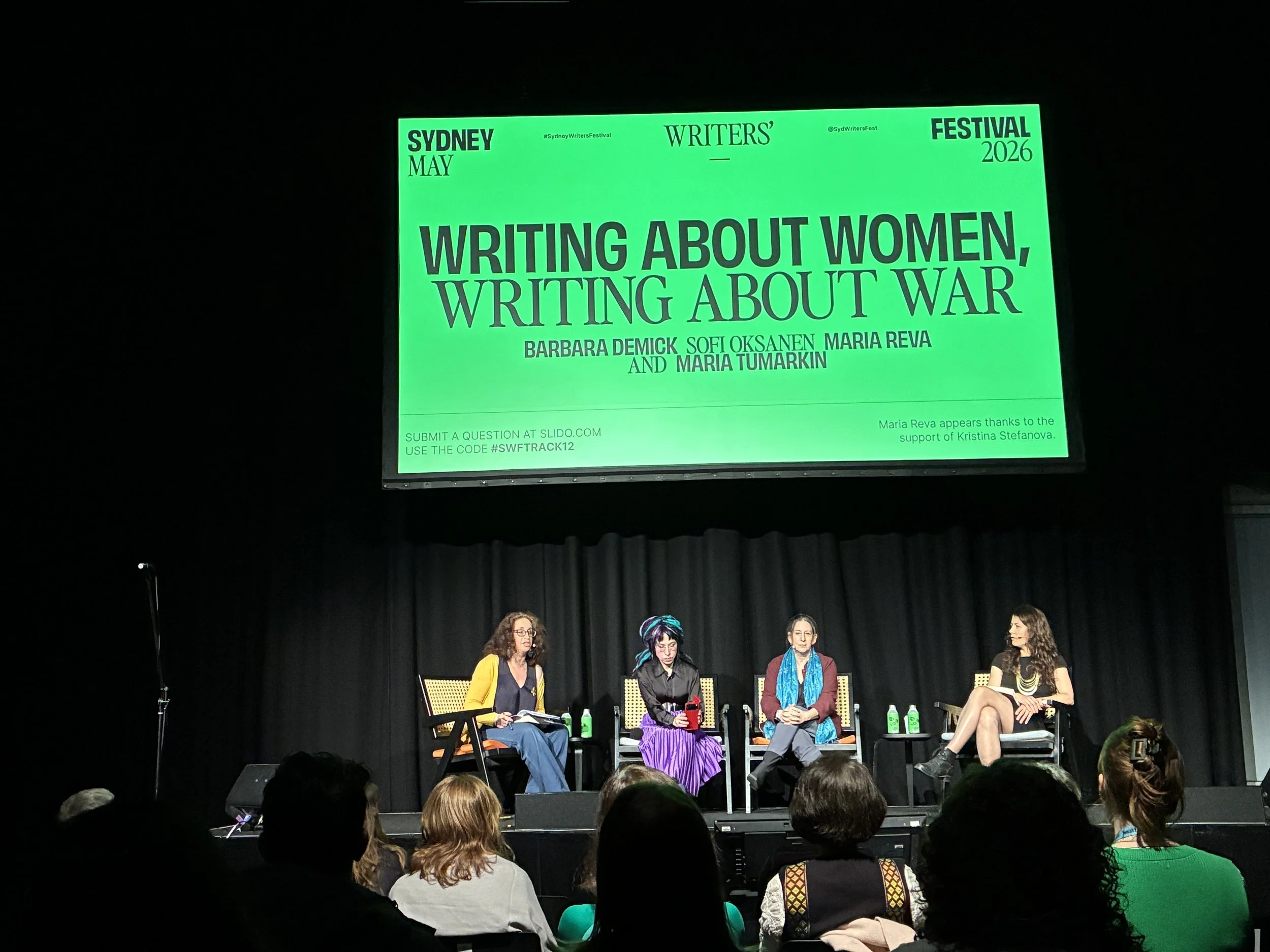
From L - R: Maria Tumarkin, Sofi Oksanen, Barbara Demick and Maria Riva