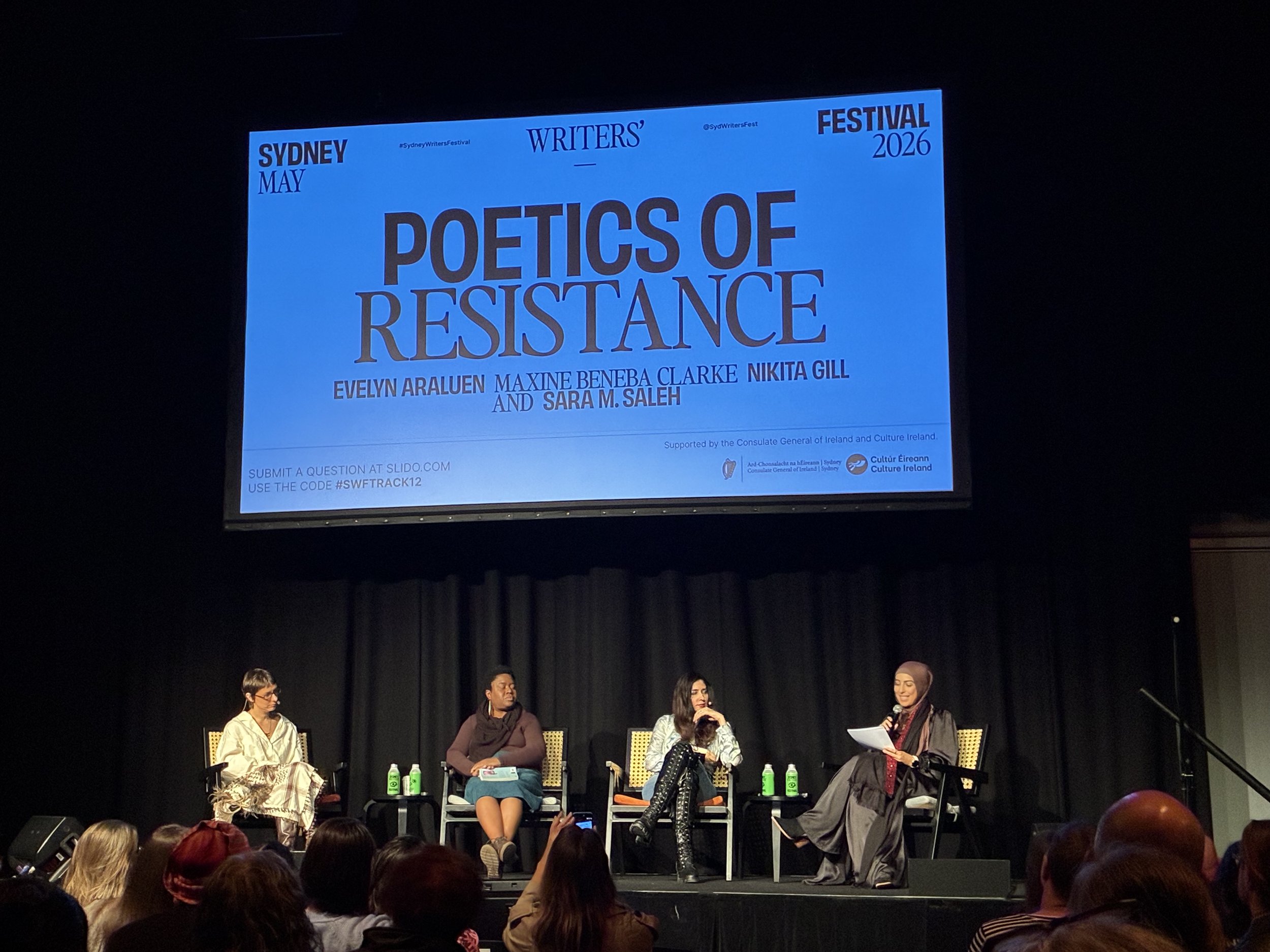
THE POETICS OF RESISTANCE - Sydney Writers Festival 2026
The poetics of resistance: Evelyn Araluen, Maxine Beneba Clarke, Nikita Gill and Sara M. Saleh
This is the first of five blogs I’m aiming to write about this year’s Sydney Writers Festival, which ran from Monday 18 May to Sunday 24 May. It was one of the best writers’ festivals I’ve ever been to. I scribbled notes frantically for myself, not intending to blog them, but I ended up writing so much about several of the sessions - too much for an instagram post (perhaps too little for an actual blog) - that I’m sharing my scribbles here. First up, some fragments from a conversation about poetry.
This was a thrilling, bracing session: four brilliant writers discussing poetry as perhaps the most potent of all art forms for resistance, activism, protest, change: Irish-Indian poet, playwright, writer and illustrator Nikita Gill, author of verse novel Hekate: The Witch (2025); Maxine Beneba Clarke , an Australian poet and writer of Afro-Caribbean descent and author of over 16 books, including her award winning memoir The Hate Race (2016) and poetry collection beautiful changelings (2025); Goorie and Koori poet, writer, editor, academic Evelyn Araluen, author of the acclaimed, award winning poetry collections Dropbear (2021) and The Rot (2025); and moderator award winning writer, poet of Palestinian, Egyptian and Lebanese heritage Sara M. Saleh , whose debut novel Songs for the Dead and the Living was published in 2023.
Nikita Gill writes about women and war. Her grandfather survived the Partition of India. She asked, Who does the cleanup? Women do. We normalise the violence against women and children - doubly so in war. Poets are emotional historians of humanity. Take the most dismissed person and write from their perspective.
Myths and speculative fiction allow you to do things with poetry that realism can’t do. Hekate, the protagonist of her debut novel Hekate, is a refugee goddess. We’re so much closer to being refugees than we are to being billionaires.
Maxine Beneba Clarke answered the question about the power of poetry and myth by telling a story about high school and her boyfriend’s mother. After she blitzed her exams, doing better than said boyfriend, his mother said to her, Don’t get too blinded by ambition, boys don’t like ambition, successful girls. Maxine tried to write about this experience literally for 20 years. Only when she wrote about it in her poem ‘Icarus’ (about a girl who flies too close to the sun and relishes her moment of glory, in her 2021 collection How Decent Folk Behave), did she finally nail the story. Readers totally got it.
Evelyn Araluen said she learned textual resistance from Edward Said who learnt about it from Franz Fanon.
Sara M. Saleh responded: ‘Throwing grains of sand at the machine of capitalism.’
Evelyn said that people move from knowing to action via emotion. Poetry is good at activating emotional reactions - possible the best of all art forms.
Maxine: Beautiful in itself is political.
Nikita: Every poem is political.
Asked about the state of publishing, Evelyn said she was exploring small scale publishing initiatives and storytelling that’s restorative for ourselves, our communities and our lands. We don’t make paper in this country. Her explorations are prompted by her decision to leave her publisher, University of Queensland Press, in solidarity with Jazz Money, a fellow Aboriginal storyteller, after UQP decided to pulp Jazz Money’s children’s picture book, Bila, A River Cycle, which was illustrated by Matt Chun, ‘without due process, communication, respect or consideration’.
Maxine: We’re in a society that responds to short forms like poetry.
Nikita: The work of Audre Lorde made me feel normal as a queer girl who loved girls. I’m bisexual.
Asked by Sara whether they were morning or nighttime writers they all said: nighttime.
Words are nocturnal, said Nikita.