An evening with R.F. Kuang - Sydney Writers' Festival 2026
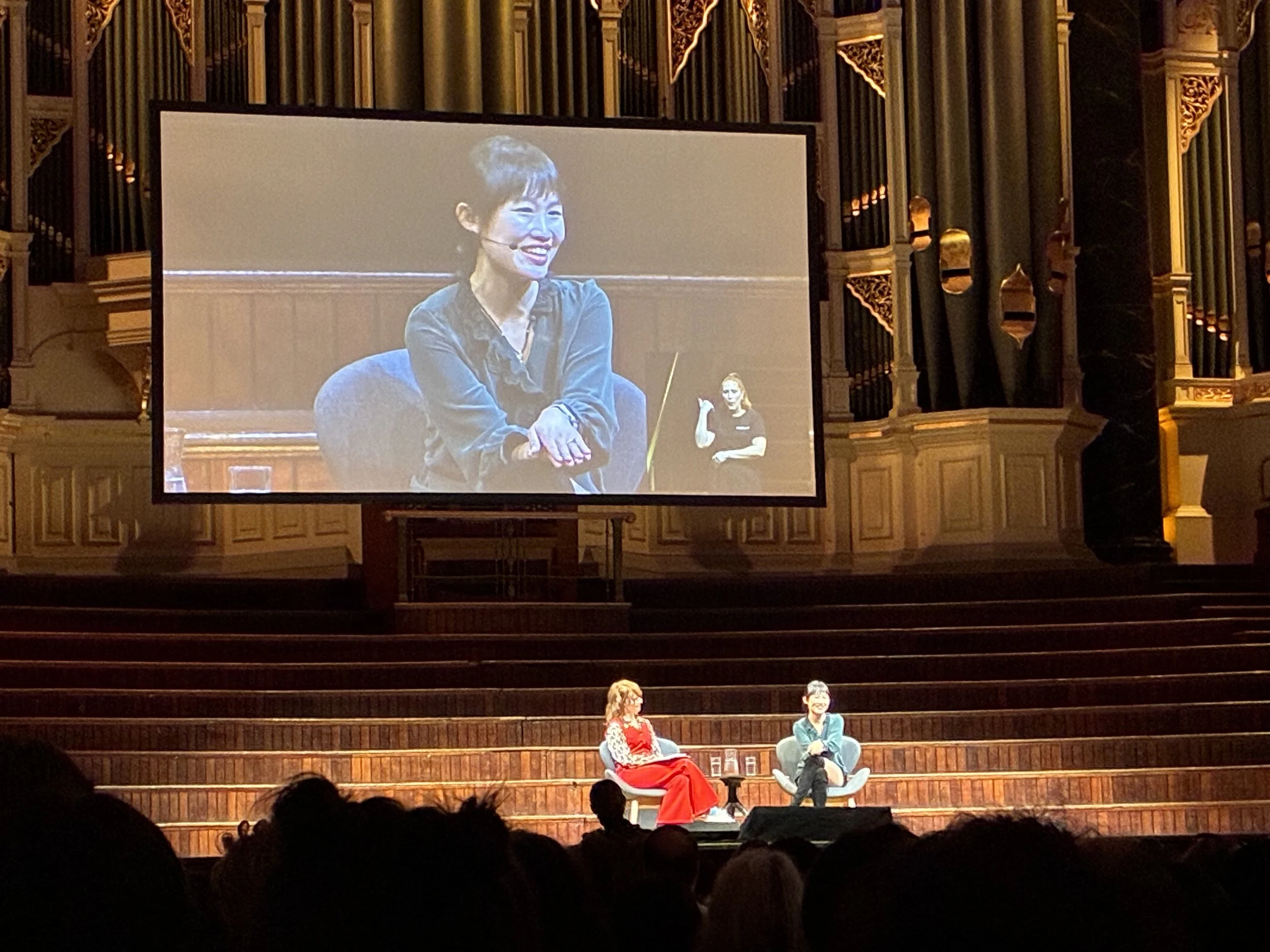
R.F. Kuang in conversation with Carody Culver, Saturday 23 May 2026
This event with R.F. Kuang at the Sydney Town Hall was a last-minute addition to the Sydney Writers’ Festival program, offered because the original session had sold out in minutes. Such is Kuang’s pull. I get it. I can’t remember hearing a better live conversation between writers, ever. Even on this second night the town hall was packed with avid fans - and me, a total newbie. I’m yet to read Kuang. I was there because her latest novel is called Katabasis, one of my favourite words. Kuang is the award winning, bestselling author of the Poppy War trilogy (2018-2020), Babel, or the Necessity of Violence: An Arcane History of the Oxford Translators’ Revolution (2022), Yellowface (2023) and Katabasis (2025). She has a Master of Philosophy in Chinese Studies from Cambridge, a Master of Science in Contemporary Chinese Studies from Oxford, and is now doing a PhD in East Asian Languages and Literature at Yale University.
The session was moderated by writer Carody Culver, editor of Griffith Review, who achieved that rare thing: balance between allowing a writer to follow their own threads - and deftly guiding the conversation. An art that requires grace, the ability to connect genuinely with a person, and deep research worn lightly. Here are the fragments I scribbled.
When asked how she came to write her first novel, The Poppy War, Kuang said that ten years ago she was an unhappy freshman in college. She’d wanted to study international economics but then realised she hated economics and mathematics. So she found a job in Beijing teaching debate to high school students. There she learnt Chinese again [having grown up in Dallas, Texas] and reconnected with friends and family. Having never learnt about the second Sino-Chinese (Japanese) War and the history around that, she read everything she could find and decided she wanted to write a narrative about it.
Kuang decided to write a novel because she thinks memoir and biography are boring, and writing family history would be too hard. Although she knew nothing about novel writing she thought it would be easier than coding, which was the other thing she thought she might do in her spare time in Beijing. So she taught herself to write by googling character development, plot development, foreshadowing, and so on.
She has settled on an ethical and creative approach to writing outlined by Iris Murdoch in The Sovereignty of the Good (1970). Good writing involves the obliteration of the ego and curiosity about people who are nothing like you. At parties she does social research: she goes up to strangers and asks, What’s the hardest thing that happened to you in childhood?
It’s easy to ask this question in Germany because they answer immediately. She’s an introvert and would rather be in bed with a glass of wine than at a party. But then she remembers she has to do social research.
She spoke of Babel’s focus on systemic injustice, which was fuelled by her rage about the way translations have been used by colonial English translators to render, for example, Indian texts as more primitive and ignorant than they are. Violent knowledge production that has sustained colonial industrial and slave societies.
‘Why hell?’ asked Culver of Katabasis.
That’s an easy question to answer. I was having a really hard time as a PhD student. Feeling the existential despair and exhaustion of being a PhD student. At Yale. She’d thought a PhD program would be so fun, and when she and her boyfriend were accepted into their chosen universities (he at MIT), they thought they had everything sorted. But then her boyfriend got sicker and sicker … and was eventually diagnosed with a chronic illness with no cure.
She was crying the whole time through the first semester.
In the spring semester she said, I’m going to write a cute romcom about two students going to hell. In response her husband said she was probably going through some stuff.
She realised she was doing what she always does: writing through her trauma.
Culver asked about writers who inspired her.
Kuang said she is a fan of Pale Fire. Nabokov is her all time favourite writer because he’s mean, a showoff, a genius, and every sentence is ‘look what I can do’. That arrogant meanness that you can only get away with if you’re a crusty old man, but I aspire to that big dick energy.
When asked for her advice to aspiring writer Kuang said: Defamiliarise yourself with English. Read in other languages. Like my friend Vlad [Vladimir Nabokov] who wrote in English.
Katabasis is a combination of lyricism and German metaphysics from Vlad’s short story ‘The Forgotten Poet’.
Being in academia requires a …. the tortoise always imagines it’s a sliver ahead of Achilles. As a PhD student, I’m always going to stay one step ahead of the economy.
Yellowface came because it was covid and Kuang was having a bad time. Writing is a lot cheaper than therapy: she gets paid for writing but has to pay her therapist. And it was fun to write the Yellowface character in a mean way that I think Vlad would approve of.
The only reason Kuang started writing stories in the first place was to connect with her family. She wanted to perfect her Chinese so she could talk to her grandfather and ask him all about his life. But she kept putting it off because she was so obsessed with her Chinese being right and perfect. And then he died before she’d had a chance to talk to him.
She said, Laughter is the other side of grief, because it punctures grief and makes it rise again.
Her forthcoming novel, The Taipei Story, explores the ability to laugh at yourself. It’s literary influences include Ben Lerner’s debut novel Leaving the Atocha Station (2011) and the manga series BLEACH.
Kuang’s parting advice: the key to writing effective fiction is to de-centre yourself.